The way we talk about technology today feels almost nothing like it did five years ago. Back then, discussions revolved around basic cloud storage or whether a business needed a mobile app. Now, the conversation has shifted dramatically toward complex, integrated ecosystems where artificial intelligence, automation, and smart data analysis work in harmony. In the United States, a hub for global innovation, there is a constant hunger for platforms and frameworks that can explain, utilize, and scale these advanced tools. This is where the concept of droven io future technology usa steps into the spotlight. It represents more than just a search term; it signifies a growing demand for educational clarity in a sea of rapid digital change. We are witnessing a pivotal moment where understanding the “how” and “why” behind tech is just as crucial as the technology itself.
For the average professional or business owner, keeping up with the pace of change can feel overwhelming. New terms like generative AI, edge computing, and zero-trust security pop up daily. However, the underlying need remains simple: businesses want to operate faster, smarter, and more securely. The droven io future technology usa framework aims to bridge the gap between high-level tech jargon and practical, on-the-ground application. It is about looking at the horizon of American tech trends—from the startup hubs of Silicon Valley to the manufacturing floors of the Midwest—and understanding how digital transformation creates real value. This article will take you on a deep dive into the pillars of this future, exploring how artificial intelligence, automation, cloud infrastructure, and cybersecurity are converging to build the next generation of American enterprise.
The Rise of Educational Tech Platforms in the United States
There has been a notable shift in how American consumers and businesses consume tech information. In the past, if you wanted to learn about a new software, you had to sit through a sales pitch or read a dense, technical manual. Today, users are smarter and more skeptical; they crave unbiased, educational content that respects their intelligence. This is precisely why interest in resources like droven io future technology usa has exploded. People don’t just want to buy a tool—they want to understand the philosophy behind it. They want to know if a specific innovation fits their unique workflow before they invest time and money.
This rise of educational platforms is a response to the “information overload” crisis. Because technology evolves so fast, traditional education often lags behind. Universities are teaching coding languages that may be obsolete in five years, while online platforms provide real-time updates on AI advancements . The droven io future technology usa phenomenon sits at the intersection of this need. It acts as a curator, filtering the noise and presenting actionable insights about cloud computing, machine learning, and digital transformation. By focusing on clarity rather than complexity, these platforms empower a wider range of people—not just IT directors—to participate in the digital economy. This democratization of knowledge is a key driver of sustained innovation across the United States.
Artificial Intelligence as the Core Driver of Change
When we discuss the future of technology in the USA, we cannot avoid the central role of Artificial Intelligence. AI has moved beyond the realm of science fiction and spreadsheets; it is now the engine of customer service, logistics, and even creative design. The droven io future technology usa narrative often highlights AI as the primary protagonist in this story. It is the tool that allows a small business to compete with industry giants by automating personalized marketing, or the mechanism that helps a hospital predict patient influx and manage resources efficiently. AI is essentially giving “superpowers” to existing systems, allowing them to learn, adapt, and predict outcomes without human intervention.
However, the conversation around AI has matured significantly. We are no longer just asking, “What can AI do?” but rather, “How do we manage what AI does?” Issues of bias in algorithms, data privacy, and ethical implementation are at the forefront of the American tech dialogue . The platforms associated with droven io future technology usa frequently address these challenges, offering frameworks for responsible AI adoption. It is not just about automating a task to save money; it is about ensuring the automation aligns with brand values and regulatory standards. As AI integrates deeper into healthcare, finance, and law, the educational role of these platforms becomes critical, ensuring that innovation does not outpace responsibility.
Automation and the Future of the American Workforce
There is a persistent myth that automation is the enemy of the human worker. Movies and media often paint a dystopian picture of robots replacing humans entirely. Yet, the reality unfolding in the USA today is far more nuanced and optimistic. The focus of droven io future technology usa in the context of automation is on augmentation, not replacement. By automating repetitive, low-value tasks—like data entry, invoice processing, or basic customer queries—businesses free up their human talent to focus on strategic thinking, creative problem-solving, and emotional intelligence, areas where machines still fall short .
Take the example of a logistics company that automates its inventory tracking. The staff no longer needs to spend four hours a day manually updating spreadsheets. Instead, they can analyze the data the automation provides to optimize shipping routes or improve supplier relationships. This shift changes job descriptions, but it also elevates the value of the employee. The droven io future technology usa approach to workforce planning emphasizes upskilling and reskilling. American companies are realizing that their return on investment in technology doubles when they invest equally in training their people. The future workplace is a collaborative dance between human intuition and digital precision, and understanding this synergy is key to staying relevant in the job market.
Cloud Computing: The Invisible Backbone
You cannot have future technology without a place to run it, and that place is the cloud. Cloud computing has evolved from a simple data storage solution to a sophisticated operating environment for the entire enterprise. The droven io future technology usa discussion often highlights how hybrid cloud and multi-cloud strategies are becoming the standard for American businesses. Why? Because putting all your eggs in one basket—relying on a single public cloud provider—can be risky. Companies are now mixing public clouds, private clouds, and on-premise infrastructure to create a “best of all worlds” scenario that balances cost, security, and performance .
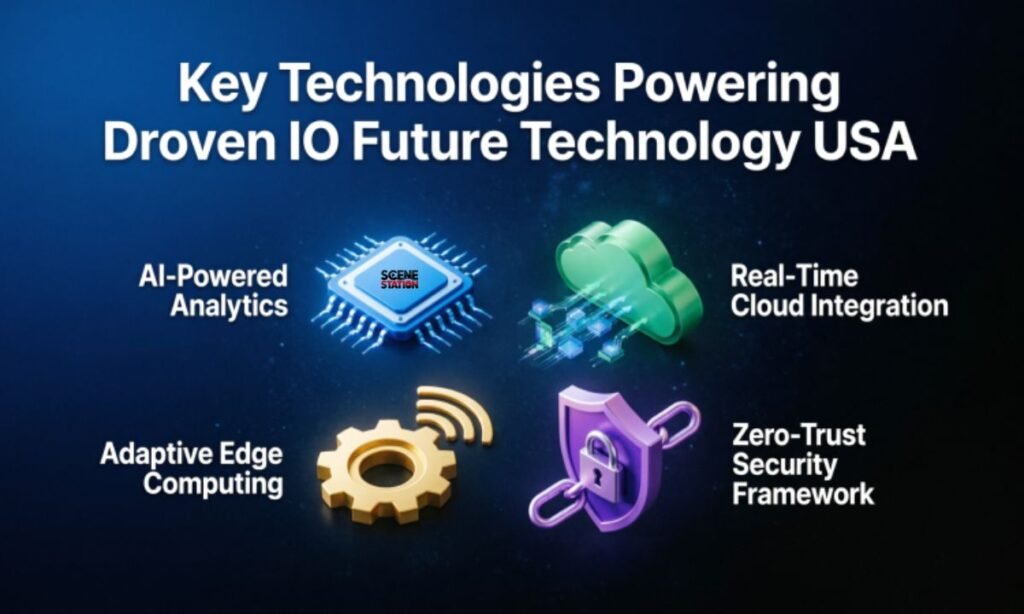
The scalability offered by modern cloud architecture is truly game-changing. A startup in a garage can access the same computing power as a Fortune 500 company, paying only for what they use. This levels the playing field and fuels the entrepreneurial spirit that the USA is famous for. As AI models become larger and require massive amounts of processing power, the cloud provides the elasticity to handle those heavy workloads without crashing. Furthermore, the integration of edge computing—processing data closer to where it is generated rather than in a central data center—is extending the power of the cloud to Internet of Things (IoT) devices. Whether it is a smart sensor on a factory floor or a self-driving car analyzing traffic, droven io future technology usa relies on a robust, invisible, and incredibly fast cloud infrastructure to make the magic happen.
Cybersecurity in a Hyper-Connected Age
As we add more smart devices, automate more processes, and move more data to the cloud, we inevitably expand the “attack surface” for cybercriminals. The future of technology cannot be bright if it is insecure. Consequently, cybersecurity is no longer just the job of a silent IT team in the basement; it is a board-level priority. In the realm of droven io future technology usa, security is treated as a foundational layer, not an add-on. We are seeing the rise of “Zero Trust” architectures, where every access request is verified as if it originates from an open network, regardless of where the request comes from.
AI is playing a dual role here: it helps defenders and attackers. On the defense side, AI-driven security systems can analyze network traffic in real-time, spotting anomalies that indicate a breach much faster than a human could. They can automatically isolate infected systems and patch vulnerabilities before they are exploited . The educational content surrounding droven io future technology usa often breaks down complex regulatory compliance issues, such as GDPR or CCPA, helping businesses navigate the legal landscape of data protection. For the average American user, this means greater trust in digital services. For businesses, it means resilience. In the coming years, a company’s reputation for security will be just as valuable as its brand name.
Digital Transformation Strategies for Modern Enterprises
For legacy enterprises—think banks, insurance companies, and manufacturers—”digital transformation” is a daunting phrase. It implies ripping out decades-old systems and starting from scratch, which is expensive and risky. However, droven io future technology usa promotes a more pragmatic approach: modernization through integration. It is not about throwing away the old mainframe; it is about building a “digital layer” on top of it using APIs (Application Programming Interfaces) and microservices. This allows the old system to communicate with new, agile cloud-native applications .
This strategy allows big companies to move at the speed of a startup. A retail chain, for example, can keep its legacy inventory system but add a modern AI forecasting tool that pulls data from that system to predict demand. The key to success here is data governance. If the data going into the system is messy or siloed, the output will be garbage. Therefore, droven io future technology usa emphasizes the importance of “data hygiene” and establishing clear metrics for success (KPIs). It is not enough to implement new tech; you must measure whether it improves customer satisfaction, reduces downtime, or increases revenue. By breaking transformation down into small, measurable steps, American enterprises can reduce risk and build momentum toward a fully optimized future.
The Role of Quantum Computing on the Horizon
While AI and cloud computing are the present, quantum computing is the tantalizing future that is just beginning to peek over the horizon. The droven io future technology usa conversation is slowly warming up to quantum because of its potential to solve problems that are impossible for classical computers. We are talking about simulating molecular structures for drug discovery, optimizing complex supply chains involving millions of variables, and breaking current encryption standards (which is why quantum-resistant cryptography is also a hot topic). For the United States, maintaining leadership in quantum computing is a matter of national strategic importance.
However, it is crucial to temper expectations. Quantum is not going to replace your laptop next year. The technology is still largely confined to research labs, requiring near-absolute-zero temperatures to function. Yet, the educational platforms covering droven io future technology usa are wise to introduce these concepts now. By understanding the basics of qubits, superposition, and entanglement, a business leader today can start preparing for the “post-quantum” world. They can ensure their data encryption is future-proof and identify which specific business problems (like logistical routing or financial risk modeling) might benefit from quantum acceleration in the next decade. It is about being ready, not reactive.
Overcoming the Skills Gap
One of the loudest discussions in the American tech industry is the “skills gap.” There are millions of high-paying tech jobs available, yet employers claim they cannot find people with the right skills. The droven io future technology usa framework addresses this head-on by advocating for continuous, lifelong learning. The days of getting a degree and coasting for forty years are over. Now, a coder might need to learn a new framework every six months, and a marketer needs to understand how to prompt an AI art generator.
Closing this gap requires a cultural shift in how we view education. Traditional four-year degrees are being supplemented (and sometimes replaced) by boot camps, online courses, and corporate training programs. The platforms discussing droven io future technology usa often serve as the textbooks for this new era. They translate the needs of the market into digestible lessons. For the individual worker, embracing this change is scary but rewarding. The future belongs to those who are curious and adaptable—those who see a new automation tool not as a threat to their job, but as a tool to make their current job easier and more interesting. For the USA to remain competitive, fostering this mindset is non-negotiable.
Ethical Frameworks and Responsible Innovation
With great power comes great responsibility. As American engineers build algorithms that can decide who gets a loan, who is flagged by law enforcement, or what news you see, ethical questions become impossible to ignore. The droven io future technology usa dialogue increasingly includes voices from the humanities, ethics boards, and public policy. It is no longer enough to ask “Can we build this?” We must also ask “Should we build this?”
Responsible innovation means building transparency into AI systems. It means auditing datasets for historical biases before training a model. It means designing user interfaces that prioritize consent and data privacy, not tricking users into giving away their information. The platforms that succeed in the future will be those that hold tech accountable while still celebrating its potential. By integrating ethics into the tech education curriculum, droven io future technology usa helps ensure that the next generation of developers builds a digital world that is fair, inclusive, and safe. It shifts the narrative from “move fast and break things” to “build thoughtfully and sustain things.”
Conclusion
The trajectory of technology in the United States is nothing short of exhilarating, yet it demands a level of literacy we have never required before. Looking across the landscape, from the rise of generative AI to the quiet hum of cloud data centers, one thing is clear: knowledge is the ultimate competitive advantage. The concept of droven io future technology usa encapsulates this need perfectly. It is a bridge between the breakneck speed of innovation and the practical realities of running a business or building a career.
We have explored how AI serves as the engine, automation restructures the workforce, cloud computing provides the infrastructure, and cybersecurity acts as the shield. We have touched upon the distant promise of quantum computing and the immediate necessity of closing the skills gap. For the American professional, the path forward involves curiosity and caution—embracing new tools like those discussed within the droven io future technology usa ecosystem while critically evaluating their impact. The future is not something that just happens to us; it is something we build, line by line of code and decision by decision. By staying informed and adaptable, we ensure that technology serves humanity, creating a future that is not only smarter but also more equitable and robust.
Frequently Asked Questions
What exactly does the term “droven io future technology usa” refer to?
The term primarily refers to a conceptual framework and educational content hub focusing on the integration of emerging technologies like AI, automation, and cloud computing within the United States. It is less about a specific software product and more about understanding the trends and strategies driving digital transformation in American businesses .
How is Droven io future technology usa different from traditional tech companies?
Unlike traditional vendors that sell a specific software license, the entities associated with this keyword generally prioritize education and information dissemination. They help users understand complex tech ecosystems (like hybrid cloud or machine learning) without a direct sales agenda, focusing instead on strategic knowledge transfer and innovation literacy .
Can small businesses in the USA benefit from these future technologies?
Absolutely. The democratization of cloud computing and AI tools means that small businesses can now access enterprise-grade power without massive upfront costs. By utilizing automation for administrative tasks and AI for customer insights, small businesses can compete more effectively with larger corporations, often using the educational guides found under droven io future technology usa to navigate these choices.
What are the main challenges associated with adopting this level of technology?
The primary challenges include the skills gap (lack of trained personnel), legacy system integration (making old software talk to new AI), and cybersecurity risks. Additionally, data governance—ensuring the data fed into AI systems is clean and unbiased—remains a significant hurdle that requires strategic planning to overcome .
What industries stand to gain the most from these American tech innovations?
While nearly every industry will feel the impact, healthcare (diagnostics and drug discovery), finance (fraud detection and algorithmic trading), logistics (supply chain optimization), and manufacturing (predictive maintenance) are seeing the most immediate gains. The educational resources tied to droven io future technology usa help these sectors apply general tech principles to their specific regulatory and operational contexts .
How does automation affect job security for American workers?
Rather than eliminating jobs, the current wave of automation is transforming them. It removes repetitive, mundane tasks, allowing workers to focus on higher-value activities like strategic planning and customer relationships. The key to job security lies in upskilling—learning to work alongside AI tools, which is a central theme of the droven io future technology usa discussion on workforce development .
Is quantum computing included in the current future tech roadmap?
Yes, though it is a longer-term horizon. While practical, error-corrected quantum computers are likely years away, the research is advancing rapidly. Current roadmaps include preparing for “post-quantum cryptography” to secure data against future quantum attacks and exploring quantum-inspired algorithms that run on classical machines to solve optimization problems today.