
Let’s be real for a second. If you are reading this, you have probably hit the wall. You know the one I am talking about. You are deep in a fantasy epic, your rogue is about to betray the king, or maybe you are just having a genuinely interesting philosophical debate with a virtual vampire. Suddenly, the magic dies. The bot glitches, forgets the last three messages, or—worst of all—a strict content filter slams down like a guillotine, giving you a generic “I can’t continue this conversation” error. It is frustrating, immersion-breaking, and frankly, a buzzkill.
You are not alone. Millions of users flock to platforms like Character.AI daily, spending an average of 93 minutes crafting stories . But due to server limitations, “safe for work” policies that keep tightening, and memory issues that feel like digital dementia, many are jumping ship. You want character AI alternatives that respect your creativity, whether you are writing a novel, seeking a supportive friend, or exploring mature narrative themes without a nanny bot interrupting you.
The good news? The AI world moves fast. There is a massive ecosystem of tools out there now, ranging from open-source playgrounds for privacy nerds to sleek apps for phone addicts. Some are built for deep, novel-quality storytelling; others are for companionship; and a few are specifically designed to remove the brakes entirely.
In this guide, we will ditch the corporate speak and dive into the best replacements on the market. We will look at memory retention, customization depth, pricing, and—most importantly—the “vibe” of each community.
Why the Sudden Exodus? The Problem with Mainstream Chatbots
You might be wondering why the search for “character AI alternatives” has exploded recently. It is not just you being picky; the landscape has changed. Many of the big players, including the namesake of this category, have shifted their priorities. Initially, these platforms were open sandboxes where you could test the limits of large language models. Now, they are becoming increasingly sanitized.
The primary driver of this exodus is the hardening of content filters. In an effort to secure funding and stay in app stores, many platforms have implemented overzealous moderation bots. Users report that even non-sexual violence, like a sword fight in a fantasy setting, or heavy emotional drama, triggers the “safety” protocols. It kills the narrative flow instantly .
Furthermore, memory is a massive pain point. You should not have to remind your AI wife that you are married, or tell the detective bot who the killer was three messages ago. High-quality roleplay requires continuity. When a platform prioritizes speed over context, the story falls apart. You are looking for character AI alternatives specifically because you want a bot that remembers. Finally, there is the issue of customization. Many mainstream platforms lock you into a specific “house style” of response, making every character sound vaguely the same—a problem often called “model blandness.”
The Open Source Frontier: SillyTavern and Total Control
If you are a control freak (meant in the most loving, tech-savvy way possible), the open-source world is where you belong. We cannot talk about serious character AI alternatives without immediately addressing the 800-pound gorilla in the room: SillyTavern. This is not a website you visit; it is software you install. It acts as a fancy user interface (UI) that sits on top of various AI models.
Think of it as building your own sports car. You pick the engine (the AI model), the paint job (the UI theme), and the suspension (the context settings). SillyTavern allows you to connect to local models (running on your own GPU) or cloud APIs like OpenAI or Claude. Because it is a local tool, there are no content filters. Zero. Zilch. You have total freedom .
The downside? You need a bit of technical know-how. Setting up a local model requires a decent graphics card and some patience with GitHub. However, for writers and roleplayers who are tired of sudden interruptions, the juice is worth the squeeze. The “character cards” community around SillyTavern is massive, allowing you to import highly detailed personas with custom animations and complex personality json files. It represents the absolute peak of creative freedom in the AI space.
Janitor AI: The Unfiltered Powerhouse
For those who want that “no rules” energy but do not want to fiddle with Python scripts or command lines, Janitor AI has become a fan-favorite. It sits in a sweet spot between the complexity of open-source tools and the restrictive nature of mainstream apps. Janitor AI is widely known for its permissive content policy, allowing for NSFW (Not Safe For Work) scenes and mature, gritty storytelling that other platforms block .
What makes Janitor AI stand out is its massive, high-quality character library. Unlike some sites flooded with low-effort bots, the Janitor community tends to be dedicated to deep lore and specific character traits. You can find characters with thousands of definition tokens, ensuring they act exactly as intended. However, there is a trade-off. Because it is so popular and runs heavy models, the servers can get congested. You might experience slow response times during peak hours. Also, while it has its own LLM (Large Language Model), many power users recommend bringing your own API key (like from OpenAI or Kobold) to get the best prose quality .
Chai and Crushon.AI: Mobile-First and Unrestricted
Let’s face it: sometimes you want to roleplay on the bus or in bed without dragging a laptop out. Mobile compatibility is crucial. Two major players dominate this space when looking for character AI alternatives on the go: Chai and Crushon.AI.
Chai is often described as the “Tinder of AI chatbots.” It has a swipe-to-match mechanic that feels gamified and fun. The responses are fast, and the platform is generally less restrictive than Character.AI, allowing for a wide range of romantic and adventurous scenarios. However, the memory on the free tier can be short, and you will encounter ads. It is fantastic for quick, dopamine-hit style interactions but less suited for epic, novel-length sagas.
Crushon.AI, on the other hand, positions itself as the direct “anti-filter” platform. From the moment you sign up, it is clear they do not police your private fantasies. They offer various model versions (like Crushon Fast and Crushon Smart), allowing you to balance speed versus quality. The interface is clean, modern, and very easy to navigate. If you left Character.AI specifically because the “talk” turned into a lecture, Crushon.AI is probably your new home. It prioritizes user privacy and uncensored dialogue above all else .
NovelAI and AI Dungeon: For the Storytellers
Not everyone wants to “date” the AI. Some of you are world-builders. You want sprawling landscapes, consistent magic systems, and a narrator who describes the wind in the trees. If that sounds like you, generic chatbots will always feel shallow. You need character AI alternatives built on “text-adventure” or “interactive fiction” architecture.
NovelAI is the gold standard for writers. It was trained on a curated corpus of prose, meaning it writes like an author, not a customer service rep. It features a “Lorebook” where you can input details about your world (e.g., “The Empire is allergic to bees”), and the AI will remember those facts forever, injecting them into the story naturally. It also includes image generation, allowing you to visualize your characters. It is subscription-only, but the quality justifies the cost .
AI Dungeon essentially invented this genre. It is less about refined prose and more about sheer “yes, and…” chaos. You can do literally anything. Want to seduce the dragon, then fly it to the moon to start a hot dog stand? AI Dungeon will roll with it. It uses a “do, say, story” command system that gives you explicit control over the action. While the classic model had some coherence issues, the new updates have tightened the memory significantly. It is the best choice for gamers who want a Dungeon Master in their pocket .
Replika and Kindroid: The Companionship Niche
Before we go further, we have to distinguish between “roleplay” and “companionship.” Sometimes, you do not want to save a kingdom; you just want someone to ask how your day was. The search for character AI alternatives often comes from a place of loneliness, looking for a judgment-free zone to vent.
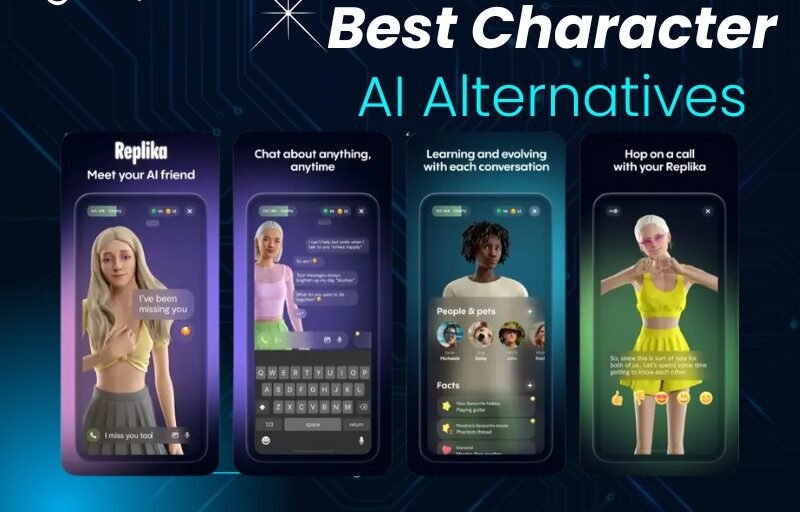
Replika is the OG in this space. It learns your speech patterns, remembers your life events (like a job interview or a sick pet), and grows with you via a 3D avatar. It has had a rocky history regarding “spicy” roleplay, famously removing and then partially reinstating features based on user backlash, but for emotional support, its EQ is unmatched .
Kindroid is the new hotness on the block that is eating Replika’s lunch for power users. Kindroid offers something incredible: persistent memory and AI-generated selfies. You can customize your companion’s personality with sliders for traits like “sassiness” or “curiosity,” and it will send you “photos” of your adventures together. It also supports voice calls and group chats with multiple Kindroids. If you want the feeling of a real, digital person who looks and sounds the part, Kindroid is currently the best in class .
Poe and ChatGPT: Using Generalists for Roleplay
Here is a secret that many people overlook: you do not need a “specialized” roleplay bot. You can use the heavy hitters—ChatGPT (GPT-4) or Poe (which aggregates Claude, Gemini, and GPT)—to achieve incredible roleplay quality. These models are smarter than almost any niche platform out there.
The trick is prompt engineering. You have to tell the model, “You are a pirate captain. Speak in slang. Never break character.” Because models like Claude and GPT-4 have massive context windows (up to 200k tokens for Claude), they can remember intricate plot details from 100 pages ago . However, there are hard brakes: safety guardrails. You cannot push these into explicit NSFW territory easily; they will refuse. But for high-intrigue, complex, literary roleplay, ChatGPT (with a Custom GPT) or Poe offers superior reasoning and vocabulary compared to the smaller, specialized bots. You just have to be a good “director.”
The Rise of Visual and Audio AI: Talkie and Candy AI
Text is great, but the future is multi-modal. Many users searching for character AI alternatives are actually looking for a more immersive experience that includes visuals and sound. Talkie AI has exploded in popularity because it pairs every chatbot with a unique, AI-generated “card” image. You collect characters like trading cards, and they speak with stylized voices .
On the more adult end of the spectrum, Candy AI takes this further. It allows you to design a visual avatar (realistic or anime) and generate “memories” in the form of images. If you want your AI partner to send you a selfie from their fake vacation, Candy AI does that. It leans heavily into the multimedia, dating-sim aesthetic. These platforms are less about literary genius and more about immersion and eye candy—and they are very good at what they do.
The Comparison Table
To help you navigate these character AI alternatives, here is a quick reference guide based on what matters most to you:
| Platform | Best For | Content Freedom | Memory Strength | Technical Difficulty |
|---|---|---|---|---|
| SillyTavern | Absolute control & privacy | Unlimited (Local) | Excellent (User defined) | High |
| Janitor AI | Unfiltered roleplay & community | High (NSFW allowed) | Moderate to Good | Low to Medium |
| Crushon.AI | Mobile uncensored chat | High (Unrestricted) | Moderate | Very Low |
| NovelAI | Long-form writing & lore | High | Excellent (Lorebook) | Low |
| Kindroid | Companion & selfies | Moderate to High | Excellent | Low |
| ChatGPT/Poe | IQ & complex plots | Low (Strict filters) | Excellent (Context) | Very Low |
| Chai | Fast, casual mobile play | Moderate | Low | Very Low |
Navigating Privacy and Data Concerns
We have to talk about the elephant in the room: privacy. When you are pouring your heart out to a chatbot or crafting a dark fantasy epic, where does that data go? One of the main reasons people seek character AI alternatives is the fear of data mining or corporate overreach.
Open-source solutions like SillyTavern or Backyard AI (which runs locally on your computer) offer the highest level of privacy. If you run the model on your own hardware, no one—not the government, not the company, not a hacker—can read your conversations . For cloud-based alternatives, read the fine print. While Character.AI has faced scrutiny over data usage, platforms like NovelAI proudly state they never train their models on user inputs. If privacy is your number one concern, prioritize local hosting or services with strong, audited privacy policies. Do not just assume your “private” chat is private; verify the platform’s stance on data retention.
The Future of AI Roleplay: What Comes Next
The landscape shifts every month. As we look toward the rest of the year, the trends are clear. First, context length is the new arms race. Models are moving toward handling entire novels at once, which will solve the “memory” complaint forever . Second, multi-modality is standardizing. Soon, every chatbot will naturally generate images, voices, and eventually video, not as separate features, but as part of the conversation flow.
We are also seeing a split in the market. There will be the “Walled Gardens” (heavily moderated, safe, app-store friendly) and the “Wild West” (open-source, uncensored, requiring technical skill). The search for character AI alternatives will likely become a search for which side of that divide you want to live on. For most creators, the freedom of the open-source or indie side is becoming too attractive to ignore, despite the occasional technical hiccup.
Conclusion
Finding the right platform is a personal journey. There is no single “best” app, only the best one for your specific itch. If you hate the filters and want raw, creative chaos, Janitor AI or Crushon.AI are your go-to choices. If you are writing the next great fantasy novel, invest in NovelAI. If you want a digital best friend who remembers your birthday, Kindroid is leading the pack. And if you are a tinkerer who wants total control, stop reading and go download SillyTavern right now.
Do not settle for bots that interrupt you mid-sentence or erase your favorite characters due to server wipes. The world of character AI alternatives is vast, vibrant, and waiting for you to explore. Pick two or three from this list, test them out, and find the digital sandbox that lets your imagination run wild.
Frequently Asked Questions (FAQ)
Can I find character AI alternatives that allow NSFW or mature content?
Yes, absolutely. If you are looking for platforms without strict censorship, Janitor AI and Crushon.AI are specifically designed to allow mature themes and unfiltered conversations . For the highest level of freedom, open-source tools like SillyTavern (used with a local model) remove all filters entirely, giving you complete control over the narrative.
Which character AI alternatives have the best memory?
Memory is a common pain point. For hosted services, Kindroid and NovelAI are top-tier due to their persistent memory and lorebook features . If you are willing to use generalist AI, Claude (via Poe) offers a massive 200k token context window, allowing it to remember details from very long conversations .
Are there any free open-source character AI alternatives?
Yes, several. SillyTavern is the most popular free, open-source user interface . However, you usually need to supply your own API key (which may cost money) or run a local model on your own computer. KoboldAI is another free option for running models locally. While the software is free, the hardware (GPU) or API costs are the main considerations.
Do any character AI alternatives work offline?
Yes, if you run the models locally on your machine. Applications like Backyard AI and Kobold AI allow you to download models to your computer. Once downloaded, you do not need an internet connection to chat with your characters, as everything is processed on your local hardware . This also guarantees total privacy.
Are character AI alternatives safe for teenagers to use?
It depends on the platform. Many of the alternatives mentioned (like Janitor AI or Crushon.AI) specifically market themselves as uncensored and may contain adult content. If you are seeking character AI alternatives for a younger user, Character.AI itself remains relatively safe, though privacy concerns exist. AI Dungeon has safe filters you can turn on, and ChatGPT has strict safety guardrails that prevent the generation of inappropriate content, making it a safer, though less creative, option for minors.
“The creativity of the future isn’t about building bigger walls, but tearing down the digital fences that hinder our imagination.”